Chest and Shoulder Workout for Beginners: My 6-Move Day 1 Plan
Founder, Muscle Man •

On this page
- The whole workout on one screen
- How this compares to Day 1 in the app
- Know the muscles before you train them
- Why I put chest and shoulders on the same day
- Warm up for 5–10 minutes
- The six exercises, step by step
- How to keep getting stronger
- Mistakes I see beginners make
- What I would skip
- Where this day fits in your week
- A 4-week version you can start Monday
- FAQ
- Start your first chest and shoulder day
Here is the honest answer to what a beginner should do on chest and shoulder day: less than you think, done properly, every week. You don't need ten exercises, a pump playlist and a supplement stack. You need a few presses, a few raises, and a way to remember what you lifted last time.
I'm Divv, and I built Muscle Man, an iPhone workout tracker with a 4-day split built in. Chest and shoulders get Monday. I put them first on purpose. It's the day most people already want to train, so it's the easiest day to show up for, and showing up is most of the game when you're starting out.
This is the exact session I would give someone on their first week in the gym. It's close to the Chest + Shoulders day in the app, but not identical, and I explain the differences below.
The whole workout on one screen
Copy this into your notes, screenshot it, or just log it in the app.
| # | Exercise | Main target | Sets | Reps | Rest |
|---|---|---|---|---|---|
| 1 | Dumbbell bench press | Mid chest | 3 | 8–12 | 90–120 sec |
| 2 | Incline dumbbell press | Upper chest | 3 | 8–12 | 90 sec |
| 3 | Seated dumbbell shoulder press | Front delts | 3 | 8–12 | 90 sec |
| 4 | Machine chest fly (pec deck) | Whole chest | 2 | 12–15 | 60 sec |
| 5 | Dumbbell lateral raise | Side delts | 3 | 12–15 | 60 sec |
| 6 | Rear delt fly | Rear delts | 3 | 12–15 | 60 sec |
- Time: 45–60 minutes with the warm-up.
- Equipment: dumbbells, an adjustable bench and a pec deck. A cable station works too.
- Effort: stop most sets with 1–3 clean reps left. If the last rep looks ugly, it doesn't count.
That's it. Big presses first while you're fresh, small isolation moves at the end.
How this compares to Day 1 in the app
Muscle Man's Day 1 is Chest + Shoulders, but it isn't a copy of the table above. In the app it's six moves: incline dumbbell press, flat bench press, chest dips, chest cable fly, shoulder press and lateral raise.
For someone in their first week, I'd change two things:
- Rear delt flies instead of dips. Dips are hard to do with clean form until you've built some pressing strength. And the app's day has no rear delt work, which is the part beginners skip most.
- Pec deck or cable fly, whichever your gym has. They do the same job.
Five of the six moves line up, so you can log those in the app as they are. Rear delt flies aren't in the app yet, so note those separately. Once bodyweight dips feel controlled, the app's version of the day is a good next step.
Know the muscles before you train them
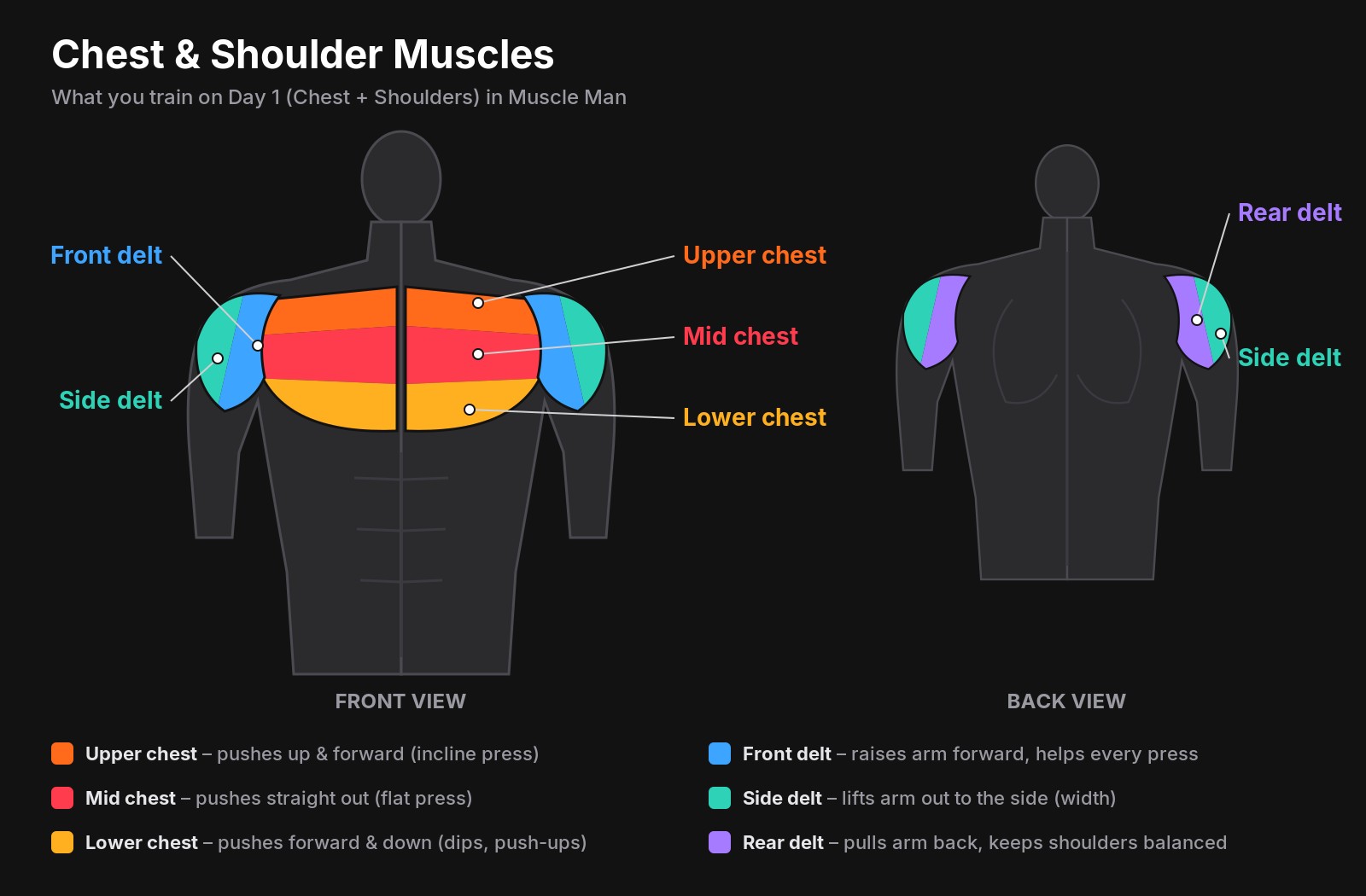
You don't need an anatomy degree. You need to know what each muscle does, because that tells you which exercise hits it.
Your chest
The main chest muscle, the pectoralis major, is one big fan. Its fibres point in slightly different directions, so it's easier to think of it in three zones:
- Upper chest. Near your collarbone. Works hardest when you press up and forward, like on an incline bench.
- Mid chest. The big middle part. Does most of the work on a flat press or a push-up.
- Lower chest. Near the bottom of your ribs. Helps most on dips and decline presses.
All three also pull your arms across your body. That's what a fly trains.
Your shoulders
The deltoid caps each shoulder and has three heads:
- Front delt. Lifts your arm forward. It already gets a lot of work from every chest press.
- Side delt. Lifts your arm out to the side. This is the one that makes shoulders look wider.
- Rear delt. Pulls your arm back. Easy to forget, and the one that keeps all that pressing balanced.
Why I put chest and shoulders on the same day
Chest presses and shoulder presses share helpers. Your front delts and triceps work on almost every pushing move. So when I designed the split, pairing them was the obvious call:
- Your front delts are already warm by the time you reach the shoulder press.
- Those shared muscles then get the rest of the week to recover before you press heavy again.
- Each session stays short and focused. Short sessions are the ones people actually finish.
Monday is push day. Tuesday is back and biceps, so you pull the day after you push. Nothing overlaps too much, and nothing gets skipped.
Warm up for 5–10 minutes
Not optional. A warm-up makes your first working set feel smooth and lets you catch anything that feels off before the weight gets heavy.
- 3–5 minutes of easy cardio. Bike, rower or a brisk walk. Get warm, not tired.
- Arm circles and band pull-aparts. 10–15 of each to wake up your shoulders and upper back.
- Push-ups. One easy set of 8–10, on your knees or against a bench if needed.
- Two ramp-up sets before your first bench press: about 10 reps at half your working weight, then about 5 reps in between.
The six exercises, step by step
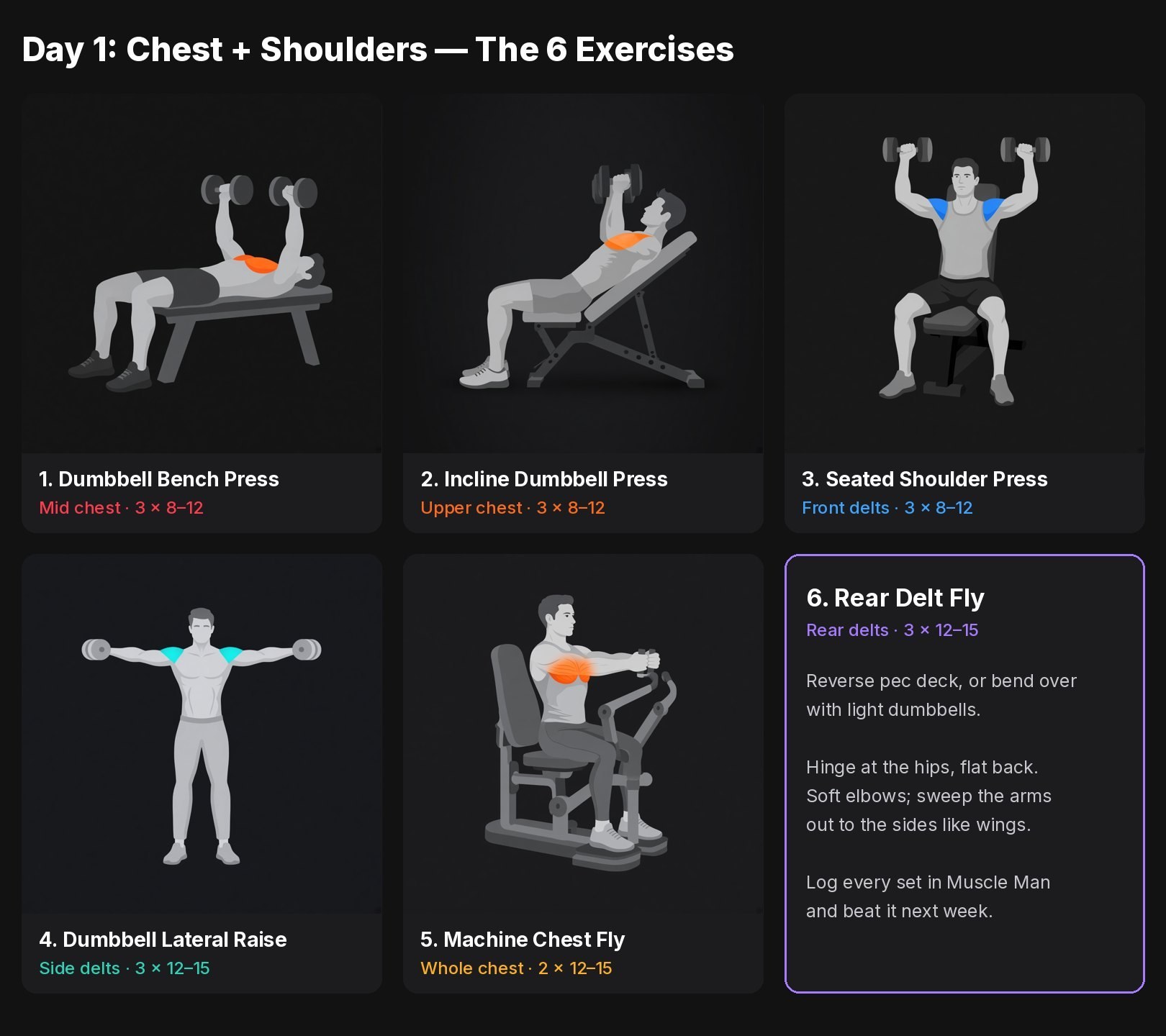
1. Dumbbell bench press (mid chest)
3 sets × 8–12 reps · rest 90–120 sec
- Sit on the end of a flat bench with the dumbbells on your thighs, lie back and bring them to chest level.
- Feet flat. Squeeze your shoulder blades together and slightly down, like tucking them into your back pockets.
- Press up until your arms are straight over your chest.
- Lower slowly, 2–3 seconds, until you feel a comfortable stretch. Press again.
Form cues: elbows about 45° from your body, not flared straight out. Wrists stacked over elbows. Butt stays on the bench.
I like dumbbells over a barbell for beginners. Each arm works alone, so your weaker side can't hide. A barbell or chest press machine is fine too. Same sets, same reps.
2. Incline dumbbell press (upper chest)
3 sets × 8–12 reps · rest 90 sec
- Set the bench to a low incline, about 30°. Go higher and your shoulders take over.
- Lie back with the dumbbells at upper-chest level, feet flat, shoulder blades pulled back.
- Press up so the weights finish over your upper chest, then lower slowly.
Form cues: chest up, shoulders don't roll forward at the top. You'll use a bit less weight than on the flat press. That's normal.
3. Seated dumbbell shoulder press (front delts)
3 sets × 8–12 reps · rest 90 sec
- Set the bench upright or just short of it and sit with your back on the pad.
- Dumbbells at shoulder height, palms forward, elbows slightly in front of your body.
- Press overhead until your arms are nearly straight. Don't bang the weights together.
- Lower back to about chin level.
Form cues: brace your stomach like someone's about to poke it. If you have to arch your lower back to get the weight up, it's too heavy.
4. Pec deck / machine chest fly (whole chest)
2 sets × 12–15 reps · rest 60 sec
- Set the seat so the handles sit at chest height.
- Sit tall, back on the pad, soft bend in your elbows.
- Bring the handles together in a wide hugging arc, then return slowly until you feel a gentle stretch.
Form cues: keep the same elbow bend the whole time. It's a hug, not a press. No machine? A cable fly or light dumbbell fly does the same job.
5. Dumbbell lateral raise (side delts)
3 sets × 12–15 reps · rest 60 sec
- Stand tall with a light dumbbell in each hand.
- Slight bend in your elbows, raise your arms out to the sides until they're about shoulder height.
- Pause for a second, lower slowly.
Form cues: push the dumbbells out toward the walls, not up to the ceiling. No shrugging, no swinging. Go light. This is the exercise where ego ruins the most sets.
6. Rear delt fly (rear delts)
3 sets × 12–15 reps · rest 60 sec
Option A, reverse pec deck: sit facing the pad, arms straight out in front, and sweep the handles back until they're in line with your body.
Option B, bent-over dumbbell fly:
- Hold light dumbbells, soft knees, hinge forward at your hips with a flat back.
- Let the weights hang under your chest with a soft bend in your elbows.
- Raise your arms out like wings to about back level, then lower slowly.
Form cues: neck relaxed, chin slightly tucked. Lead with your elbows. If you're pulling your elbows toward your hips, it's turned into a row.
How to keep getting stronger
Use double progression. It's the simplest system I know, and it's the one I'd want every beginner to start with:
- Pick a weight you can lift for the bottom of the rep range with good form, say 8 reps.
- Each week, try to add a rep or two at the same weight.
- When you hit the top of the range on every set, like 3 × 12, move up to the next dumbbell and drop back to about 8 reps.
- Repeat.
None of this works if you don't know what you did last week. That's honestly the whole reason I built a tracker. A notebook works too. Memory doesn't.
- Add weight when you've earned it with clean reps, not because it's Monday.
- On lateral raises, rear delt flies and the pec deck, stay at a weight longer. The smallest dumbbell jump feels huge on these.
- Rough week? Repeat last week's numbers. That still counts.
Mistakes I see beginners make
- Going too heavy, too soon. Your ego wants big numbers. Your joints want clean reps.
- Flaring elbows on presses. Bring them in to about 45°.
- Dropping the weight on the way down. The lowering half of the rep is half the exercise.
- Shrugging on lateral raises. If your traps are doing it, the dumbbells are too heavy.
- Training through sharp pain. Effort and mild soreness are fine. Sharp, pinching or joint pain isn't. Stop, and if it keeps coming back, see a doctor or physio.
What I would skip
Some things feel productive and aren't.
Ten different chest exercises. Two presses and a fly cover the whole chest. More variety just means you get good at nothing.
Maxing out on bench in week one. You don't need to know your one-rep max. You need to own the 8–12 range.
Skipping rear delts because you can't see them. All pressing and no rear delt work leaves your shoulders pulled forward. Keep exercise 6.
Upright rows and behind-the-neck presses. Plenty of people find them uncomfortable on the shoulder, and the moves above train the same muscles without the risk. Leave them out for now.
Changing the plan every week. The plan isn't the problem. Run it long enough to see the numbers move.
Where this day fits in your week
| Day | Workout |
|---|---|
| Monday | Chest + Shoulders (this workout) |
| Tuesday | Back + Biceps |
| Wednesday | Rest |
| Thursday | Legs + Abs |
| Friday | Arms (triceps focus) |
| Weekend | Rest or light activity |
Every muscle group gets its own focused day and you still get three rest days. Can't train Monday? Keep the order and leave one rest day somewhere in the middle.
A 4-week version you can start Monday
If you want it as a schedule:
Week 1. Learn the moves. Pick weights that feel easy, do every set with clean form, and write everything down. This week is about finding your starting numbers, not proving anything.
Week 2. Same weights. Try to add 1–2 reps to each set. Focus on slow lowering, 2–3 seconds every rep.
Week 3. Any exercise where you hit the top of the rep range on all sets, move up to the next dumbbell. Everything else, keep adding reps.
Week 4. Keep progressing. Then look back at your log. You'll have four weeks of numbers going up, and that's the best motivation there is to keep going.
Then just keep repeating it with the double progression rule.
FAQ
How often should a beginner train chest and shoulders?
Once a week with this plan is a solid start, especially since your front delts also help on other days. After a few months of consistent training, you can add a second, lighter session if you recover well.
How much weight should I start with?
Lighter than you think. Pick a weight you can move for the full rep range with smooth form and a couple of reps left over. Log it and progress from there.
Can I do this chest and shoulder workout at home?
Yes, with adjustable dumbbells and a bench. Swap the pec deck for a dumbbell fly or slow push-ups, and use bent-over rear delt flies. Same sets and reps.
Should I train shoulders before chest?
Not on this plan. Chest presses come first because they're the heaviest lifts, and they warm up your front delts for the shoulder press.
How long until I see results?
It varies a lot. Consistency, sleep, protein, calories and genetics all play a part. Most beginners notice strength going up in the first few weeks. Visible changes take longer, so stick with it.
Start your first chest and shoulder day
Take the table above to the gym and write down every set. Or let Muscle Man do most of it for you. It's built around this same 4-day split, with Chest + Shoulders as Day 1. It's free to download, it works offline, and Pro is $7.99/month or $39.99/year in the US (the App Store shows your local price) if you want the extras.
Download Muscle Man on the App Store →
Next up: Back and Biceps, Day 2 of the split.
Train with the app
Log this workout in Muscle Man
The 4-day split is built in. Log every set on your iPhone.
- 4-day split built in
- Works offline
- Sign in with Apple
- Pro $7.99/mo or $39.99/yr
- #chest workout
- #shoulder workout
- #beginner workout
- #workout plan
- #4-day split
- #dumbbell exercises
- #chest and shoulders
- #muscle diagram
Written by
Founder, Muscle Man
I build Muscle Man, a no-nonsense iPhone workout tracker, and write about the training that goes into it. More about me